How to Get Rid of Roaches and Palmetto Bugs in Columbia, SC
Finding a roach in your house is unsettling, and in the Midlands, it’s common enough that it doesn’t mean you’ve done anything wrong. Columbia’s hot, humid summers and mild winters keep cockroaches active nearly year-round, so most homeowners run into one sooner or later, and plenty eventually call a professional roach exterminator in Columbia to deal with it. The good news is that the kind of roach you’re seeing tells you a lot about how serious the problem is and what to do next.
The first thing to sort out is the species. A small German cockroach, the kind that breeds indoors, signals a true infestation. A large “palmetto bug” usually lives outside and wanders in on its own. The two call for very different responses, which is what the rest of this guide walks through: how to tell them apart, what each one means, what to do right away, and when to bring in help.
German roach or palmetto bug? Start here
In South Carolina, “palmetto bug” is the everyday word for the big roaches people notice indoors, usually American or smokybrown cockroaches, which entomologists group together as the larger, outdoor-associated species. It’s a regional nickname, not a scientific category. Telling these big roaches apart from a German cockroach is the whole game.
German cockroaches: small, indoor, and the real problem
German cockroaches are small, only about half an inch long, and light tan to brown with two dark stripes running down the back just behind the head. The female carries her egg case until it’s nearly ready to hatch. Clemson and other extension sources place them in kitchens, bathrooms, and areas near food and moisture: behind appliances, under sinks, inside cabinets, and in pantry cracks. Their droppings are a giveaway too, tiny dark specks like ground pepper or coffee grounds clustered around hinges, drawer tracks, and cabinet corners, and a heavy infestation can leave a faint musty odor. They’re an indoor species that lives and breeds alongside people, and that’s what makes them a problem.
Palmetto bugs: the big ones from outside
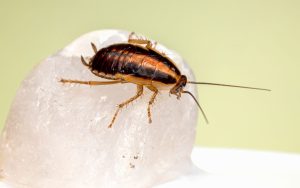
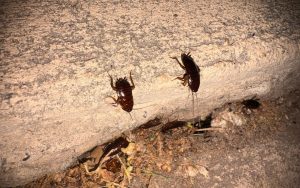
The large roaches, American and smoky brown cockroaches, are a different story. They run an inch and a half or more, reddish-brown to dark mahogany, and they mostly live outdoors. The University of Florida notes that these larger roaches develop outside in places like sewers, garages, attics, leaf litter, mulch, and tree holes, then enter homes from those outdoor sites. Smokybrowns in particular favor mulch, log piles, vegetation, gutters, attics, and crawlspaces, along with palmettos near the coast, and they can fly on warm evenings. For a closer look at the individual species, our cockroach identification guide breaks them down in more detail.
The fast homeowner test
A couple of big roaches showing up occasionally usually points to outdoor pressure and a way in. A handful of small roaches in the kitchen or bathroom, especially ones you see during the day, usually means they’re breeding inside, which is a more serious situation. That difference is the fastest way to gauge how worried to be.
What roaches in Columbia homes usually mean
When you see one big palmetto bug, it’s often a single wanderer that came in under a door, up a drain, or down from the attic. One stray doesn’t prove your house is infested. The large roaches are pushed indoors by moisture and weather, and Columbia’s humidity, mulch beds, and crawlspace-heavy homes give them plenty of harborage right outside the walls.
Small German cockroaches are the opposite. Because they breed indoors and hide in tight, warm cracks near food and water, seeing even a few points to an established infestation. Spotting one in daylight is an even stronger sign, since it usually means the hidden population has outgrown its space. They reproduce quickly, and the egg cases sit tucked away where sprays never reach. Left alone, a handful becomes many: German cockroach numbers build quietly behind walls and cabinets, so the gap between “I saw one” and “they’re everywhere” can be short. Acting while the population is still small is far easier than chasing an established one. If you’re not sure which roach you’re dealing with, that’s a normal place to start, and a quick inspection settles the species and how far it has gone.
Where they’re coming from in Midlands homes
German cockroaches stay close to food, warmth, and moisture: behind and under the refrigerator and stove, inside cabinets, around the sink and dishwasher, and in pantry and bathroom cracks.
The large outdoor roaches get in from the perimeter. Clemson points to mulch, log piles, thick vegetation, gutters, attics, and crawlspaces as prime harborage, and from there they slip inside through gaps around plumbing and utility lines, crawlspace and attic vents, and worn door sweeps. Drains and sewer connections are another common route for the big ones. Their pressure rises with the weather: the large outdoor roaches are most active in summer’s heat and humidity, and they push harder to get inside when conditions outdoors turn against them, whether that’s a dry spell, heavy rain, or the first cool nights of fall.
What you can do right away
Whichever roach you have, a few things help immediately and cost almost nothing:
- Tighten up sanitation and moisture. Wipe up crumbs and spills, store food in sealed containers, fix drips under sinks, and don’t leave pet food out overnight.
- Seal the easy entry points. Caulk gaps around pipes and cabinets, add or replace door sweeps, and screen crawlspace and attic vents.
- Cut back outdoor harborage. Pull mulch, leaf litter, and woodpiles back from the foundation, and keep gutters clear.
- Use baits, not bombs. Gel baits and bait stations work far better than aerosol sprays or foggers, and they’re safer. Foggers scatter roaches deeper into wall voids, and as the EPA notes, the proteins in roach droppings and body parts can trigger allergies and asthma, while the sprays meant to kill them can make indoor air worse. Skip the bug bomb.
For the occasional palmetto bug, the perimeter and exclusion work above does most of the job. For German cockroaches, it helps, but it usually isn’t enough on its own, which is the next thing to understand.
Why German cockroach infestations usually need a pro
DIY can knock back the occasional palmetto bug. A true German cockroach infestation is a harder fight. They breed indoors continuously, the egg cases hide in cracks and voids where store-bought sprays never reach, and survivors quickly repopulate, which is why roaches so often “come back” a week after a DIY treatment. Extension experts are blunt about this: cockroach control takes more than insecticides, and an integrated approach beats chemicals alone, with professionals carrying products and training homeowners don’t have.
Professional roach treatment for Columbia homes targets the part DIY misses: finding the harborage, treating cracks, crevices, and voids directly, placing baits the colony carries back to the nest, and following up to break the breeding cycle. For a German roach problem, that follow-through is usually the difference between gone and back in a month. If you’re seeing small roaches in the kitchen day after day, that’s the point to stop buying sprays and get a professional eye on it.
A quick word on roaches and health
Beyond the nuisance, roaches carry a real health risk. The EPA points out that proteins in cockroach feces and saliva can trigger allergies and asthma, and that the problem is more common across the southern U.S. That’s part of why getting an indoor infestation under control matters more than comfort alone, especially in a home with kids or anyone who has asthma. A roach sighting also doesn’t mean your home is dirty. Cockroaches turn up in clean houses too, drawn by warmth, moisture, and the smallest food sources. Good sanitation helps prevent them, but finding one isn’t a verdict on your housekeeping.
Roach help for Columbia, Irmo, Lexington, and the Midlands
Jeffcoat helps homeowners with roaches throughout Columbia and the surrounding Midlands, including Irmo, Lexington, West Columbia, Cayce, Chapin, Blythewood, Elgin, Newberry, and Winnsboro. It’s worth calling when you’re seeing small roaches indoors day after day, when DIY hasn’t worked, when big roaches keep finding their way in, or when someone in the home has asthma or allergies that roaches could be aggravating.
If roaches keep coming back, especially the large outdoor kind that push in when the weather shifts, a year-round pest prevention plan keeps the perimeter treated so they don’t return. Landlords, restaurants, and apartment managers dealing with roaches across multiple units can look at commercial pest control for restaurants and rentals.
Ready to deal with it? Get a roach quote, and we’ll identify what you’re up against and put together a plan for your home.